
From Campfires to AI
Dasheng Zheng and Salar Shahna share firsthand insights and reflections at AltNext 2025, sparking dialogue and new perspectives.
Feb 5th, 2026


Dasheng Zheng and Salar Shahna share firsthand insights and reflections at AltNext 2025, sparking dialogue and new perspectives.
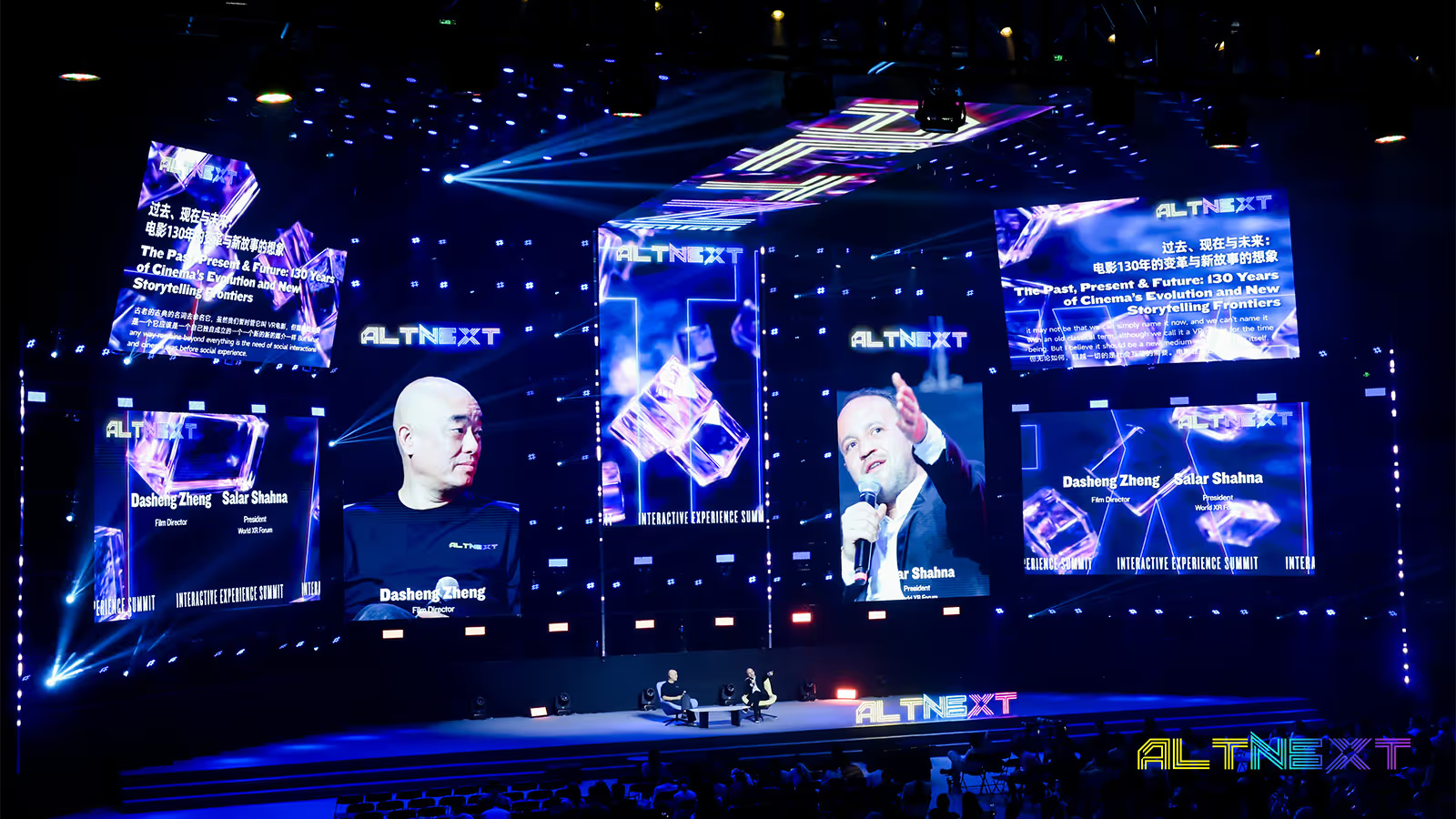
AltNext 2025 Featured Talk with Director Dasheng Zheng and World XR Forum Founder Salar Shahna
Past, Present, and Future — 130 Years of Cinema Transformation and New Storytelling Possibilities
Over the 130 years since the birth of cinema, technology has continuously reshaped the form of moving images, from silent to sound, from black-and-white to color, from the screen to immersive environments. Today, AI, VR, and emerging technologies are once again pushing cinema to a critical turning point. How will technological progress influence or even redefine what cinema and film are?
At AltNext 2025, this conversation begins at the very origin of storytelling and cinema, asking a fundamental question: when technology changes the medium, where will film and narrative go next?

Dasheng Zheng
If we really look back, the history of cinema is far longer than 130 years.
Long before film existed, humanity had already gone through an extremely long history of storytelling. The origin of all stories was likely a cave, a cold night, and a campfire on an open plain.
Humans will always need stories. I strongly agree with a historical view that civilization begins with fiction, and fiction begins with storytelling. Only when a group of people share an imagined story can they form a kind of imagined community, a tribe with a shared spiritual world. That is where civilization begins.
In this sense, the future images we discuss today, like XR, VR, and AI, can all be traced back to that original scene: a cold night, a wilderness, and a fire. It is very much like the earliest “bedtime stories.” And I believe the experience of watching a film is essentially the same.

Salar Shahna
In many ways, storytelling is essential to human survival. We live in this world without fully knowing where we come from or why we are here. Stories help us record what happened, understand ourselves, and interpret the world. Even religion may have grown from this. If we look back to the birth of cinema 130 years ago, we see that the relationship between technology and storytelling began even earlier than we tend to think.
In painting, when pigments were put into portable tubes and artists could leave their studios, a new style of painting emerged. When photography emerged, painting was finally freed from the duty of perfectly reproducing reality, and art moved toward experimentation and exploration. The arrival of cinema was a similar moment.
Dasheng Zheng
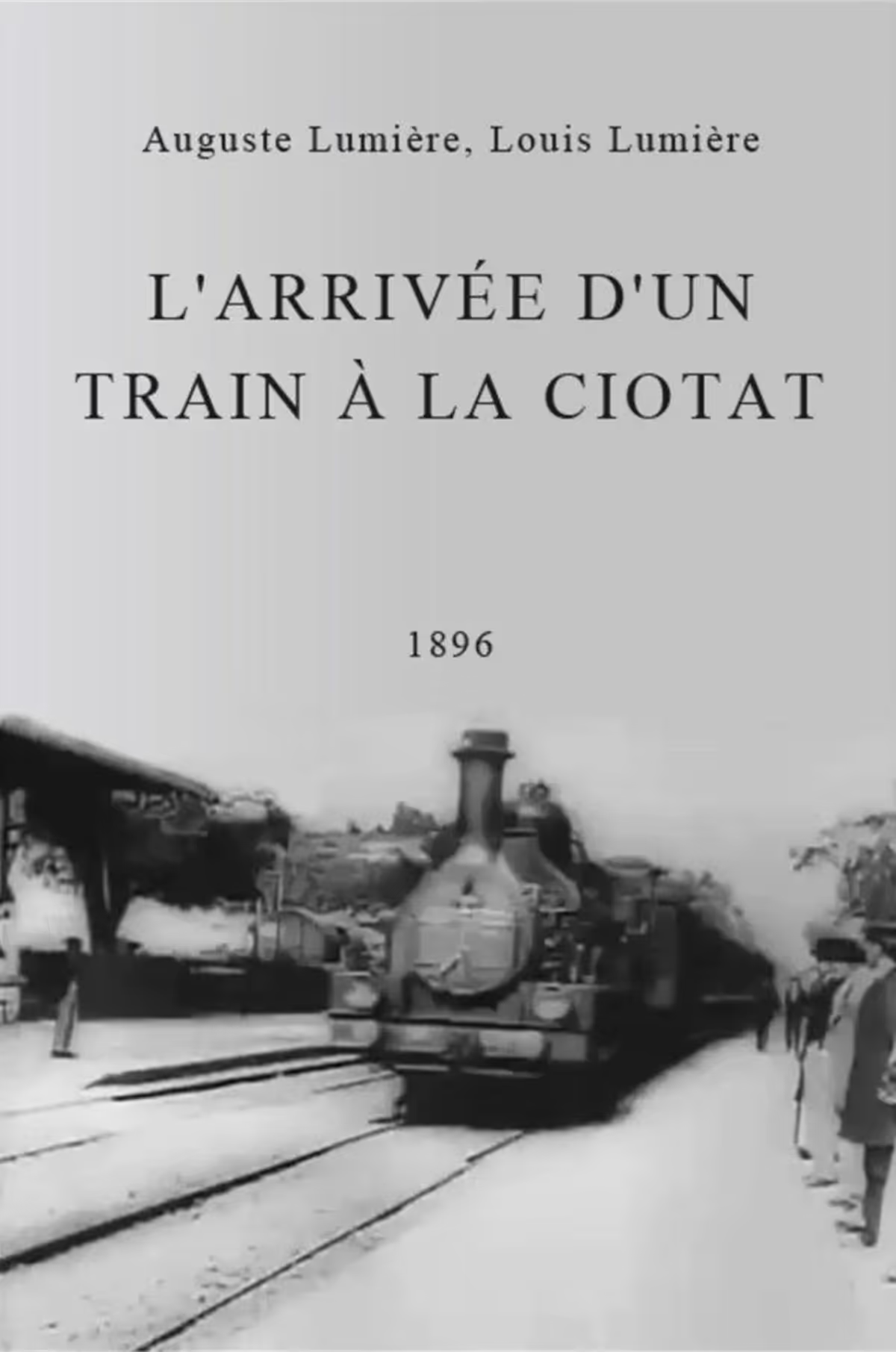
If we go back to the birth of cinema, for example, the famous L'arrivée d'un train en gare de La Ciotat, it was an extremely intense experience. When the train rushed toward the platform, the audience screamed, stood up, and even tried to run away. From today’s perspective, it was almost like an ancient version of VR. It shook people’s perception of space and reality.
Salar Shahna
Today, with AI and deepfakes, it is becoming harder to tell what is real. Media literacy will become increasingly important, especially for younger generations. We are entering an extremely complex image environment, and audiences themselves must become more mature.
Dasheng Zheng
In Eastern philosophy, reality and illusion have never been strictly separated. Buddhist thought has long suggested that what we see and feel is not necessarily real, “like a dream, a bubble, a shadow, like dew or lightning.” This ancient wisdom makes us less fearful when facing virtual reality and AI imagery, because we already understand that reality and illusion can transform into each other.
Across 130 years, cinema has been reinvented again and again. The films we watch today are not the same as those from 10 or 20 years ago. Technically, filmmakers have always tried to create increasingly “real” experiences. But cinema has always been the construction of illusion, which uses light, depth, and framing to produce a convincing sense of reality. Whether classical film, AR, XR, or future media, we still rely on stories to interpret the world and respond to it. We return to these experiences to confirm our own existence this remains constant regardless of the technology used.
Dasheng Zheng
Traditionally, film is a linear storytelling form. Interactive narrative has deeply challenged how stories can be told.
Cinema tells stories through its own language, inherently linear, with structure and progression. Its techniques depend on two-dimensional images and visual illusions to simulate a three-dimensional world. Even when complex, it remains essentially linear and based on illusions.
But when immersive and interactive experiences appear, events unfold across multiple dimensions. This may bring both opportunity and danger to traditional film.
I often use this analogy: watching a film is like looking at fish through an aquarium. Immersive media is entering the aquarium, swimming with the fish, or even becoming one. That is both exciting and challenging for cinema.
Salar Shahna
VR is a demanding medium. It requires full attention and physical space, while public attention spans are decreasing. But that does not mean it lacks value. On the contrary, it may bring us back to the idea of “going somewhere to experience a story,” like going to the cinema. Thanks to virtual reality, this paradox becomes possible.

Salar Shahna
AI is not a medium but is a tool that changes everything. It will generate a lot of repetitive, low-quality content, but it will also dramatically lower the barrier to creation. That creates opportunities for smaller markets and young creators. If you have a good story, AI helps you realize it at a lower cost. Talented writers using AI tools can close the resource gap. New hybrid filmmaking methods will require less money to achieve a vision. In principle, everyone can access similar creative power.
Dasheng Zheng
AI is strongest at repetition. The truly unknown is not in its database and that is why human creators remain irreplaceable.
I often debate with friends who believe AI cannot produce true originality. For things not in its dataset, AI cannot truly “create.” But I always ask: why can’t we imagine AI developing philosophical questions or artistic awakening? If that happens, can we still say it is not original?

Salar Shahna
We must first understand that AI is not a medium like VR; it is a foundational transformation tool. It will reshape society and labor markets. Many jobs will disappear, new ones will emerge, and the transition will be turbulent.
But this may also be a wake-up call for the film industry. Hollywood has increasingly relied on formulaic repetition, especially after streaming disrupted its business models. AI excels at repetition and imitation faster and cheaper than humans. That forces us to rethink what cinema should be. When copying becomes trivial, originality becomes essential. In that sense, AI may be the best alarm bell for innovation in film.
Dasheng Zheng
Cinema will not disappear, but it may become “classical,” like theater. Theater did not die after film, television, and the internet but still holds strong power.
Handcrafted filmmaking may one day resemble an intangible cultural art form. Meanwhile, future image-making will open entirely new storytelling modes that we cannot yet name, just as people 130 years ago did not know how to name “cinema.”
From cave fires to virtual reality, from film stock to AI generation, cinema’s 130 years of journey is both a history of technological reinvention and a human search for meaning through storytelling.
AI is reshaping production processes and breaking creative barriers. New tools may deepen immersion and efficiency, but cinema has never left its spiritual origin: in the face of cold and uncertainty, we gather together and use light and shadow to tell stories to understand the world and to recognize each other’s existence.
